

Two-year institutions are economic bulwarks for their communities, able to step in during moments of crisis. Companies may downsize, or leave the region altogether, while community colleges deploy rapid-response training both in the immediate aftermath and beyond.
Flint Hills Technical College (FHTC) sprang into action after Tyson Foods shuttered a meat-processing facility in Emporia, resulting in the loss of 800 jobs in a region of 24,000.
Tyson had been with the Kansas community for 75 years — an anchor employer that began layoffs in November 2024 and continued into 2025. The devastating economic impact was matched only by the precipitous drop in morale, says FHTC President Caron Daugherty.
This article is an excerpt from the current issue of Community College Journal, the bimonthly magazine of the American Association of Community Colleges.
“There were generations of folks who worked there,” Daugherty says. “Our response was good, but we’re always wanting to respond sooner. My concern was for the families, and what that would look like for the community.”
Located between Topeka and Wichita, Emporia has a manufacturing base that includes the J.M. Smucker Company and Hill’s Pet Nutrition, a major dry pet food producer. Simmons Pet Food, a leading manufacturer of wet pet food with operations in Emporia, also provided displaced Tyson workers with new employment.
FHTC mobilized its resources as well, facilitating short-term truck-driver training to unemployed “shag drivers” who navigate and position trailers for loading and unloading. Talks with Tyson put worker needs up front, including connections with a commercial driver’s license (CDL) program run at FHTC by CDL Coordinator Eric Crook.
“We got into Tyson and talked to the shag drivers they had,” Crook says. “Because of those conversations, we got many people inside the building into jobs. Tyson has a good training and safety culture, so the students we saw came in with a positive attitude and a knowledge base for the work. We’ve had a 100% success rate with these folks — they came in with a solid foundation and transitioned well.”
Getting to work
CDL students earn Class A and Class B licenses, qualifying them for driving positions along with future opportunities as managers, dispatchers or mechanics. Though lacking formal accreditation, the program successfully transitioned line supervisors and plant workers into commercial driving roles.
Results of the college’s efforts are reflected in the numbers, says Daugherty: In 2025, about 20% of FHTC’s workforce development completion rate was comprised of individuals directly or indirectly impacted by the Tyson closure, she notes.
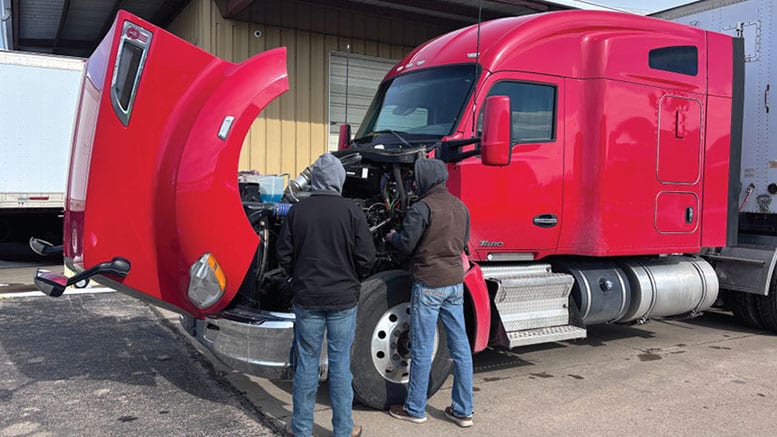
Beyond CDL instruction, FHTC is funneling career-transitioning adults into an industrial engineering pathway that offers both technical certificate and associate of applied science degree options.
Participants learn the basics of industrial and residential wiring, as well as machine and equipment repair comparable to OSHA 10 General Industry certification. Daugherty emphasizes the importance of flexibility for anyone pivoting into a new career.
“CDL is short-term training — industrial engineering is a longer program, though a one-year certificate is available,” says Daugherty. “Technical colleges are made to be agile, or to shore up (programming) within a couple of weeks. That is the arena we live in.”
Working with intention
FHTC’s engineering initiative has a nearly perfect record in placing participants into new employment. Meanwhile, Tyson workers who lost jobs paying $60,000 or $70,000 are now earning $80,000 annually as truck drivers, Daugherty says.
Local employers and community organizations are part of that success, not to mention state stipends for ongoing training. The work highlights how rural communities, in particular, must work together to rebound from life-altering career disruptions, says the FHTC president.
“We want to be in a community that looks at this work with intention, so families can stay here and raise their children in a rural environment,” Daugherty says. “That is a testament to our resilience.”
Madisonville Community College (MCC) had its own call to action amid regional coalmine closures, including the Dotiki Mine in Webster County. Dotiki, a cornerstone of the Western Kentucky coal industry, closed in 2019 at the cost of 200 jobs. A victim of stricter environmental regulations and competition from natural gas, coalmine shutdowns put the region in a tailspin that still lingers today.
“In Kentucky, there are generations of coalminers,” MCC President Cynthia Kelley says. “It’s just something you did — it paid well, and we all understood each other. You would see people on the street wearing heavy khaki clothes, which was the uniform. Mine by mine, it all disappeared.”
Kelley, who learned the importance of mining firsthand as a child in West Virginia, arrived at MCC after the downsizing began. Upon recognizing the problem’s scope, she hunkered down with fellow administrators to determine next steps.
“We saw it happening over time and were thinking on a community college level what we could do for the workforce,” Kelley says. “What could we do to help? What programs would help these folks get retrained so they can make a living wage?”
Meeting demand
Early on, the college directed laid-off miners toward welding, electrical technology and healthcare positions. A major turning point came when a Georgia-based contractor recruited local utility linemen for six-month stints out of state. Though not feasible by itself, the idea germinated into something bigger for MCC.
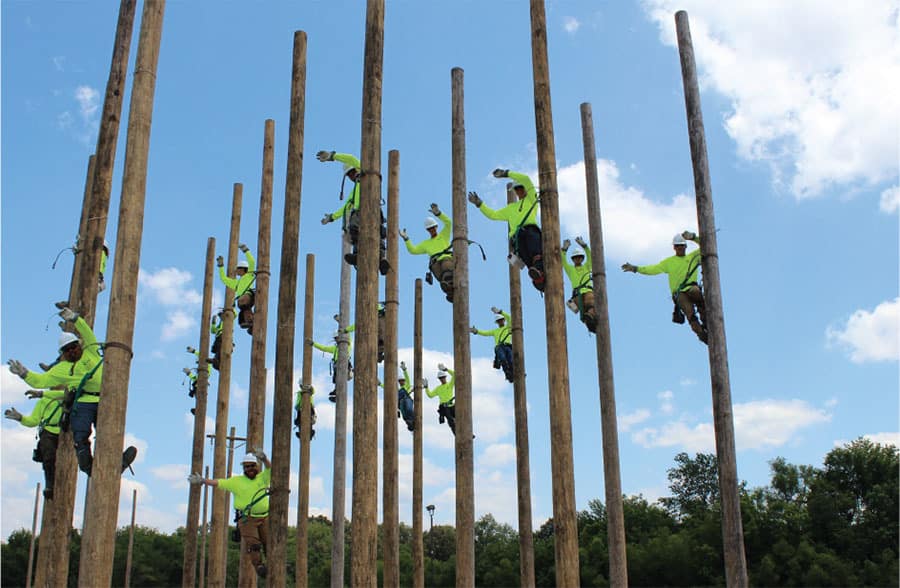
In 2022, the college converted a building at the former Dotiki mine portal into the Lisman Workforce Complex, a training center for in-demand technical careers including utility linemen. During the 10-week course, students literally climb power poles under the tutelage of industry professionals. Participants even receive pole-top and bucket rescue training as part of their skill set. The median lineman salary in the United States is $92,560, according to the U.S. Bureau of Labor Statistics.
Facing a regional linemen shortage — along with a dwindling pool of qualified CDL workers — MCC has expanded capacity for both programs alongside a new diesel technology curriculum. Collaborations with industry leaders helped propel this vital programming forward, Kelley says.
“This work built upon itself,” she says. Local industries “knew just like we did the need for line people and a distinct CDL program. It would help the entire community to get folks retrained in skills that would get them jobs. That helps our tax base and morale in the community.”